NOVAR XIO-8U-B Honeywell Opus Bacnet Remote Inputs Xio XIO.80 I/o Inputs/output
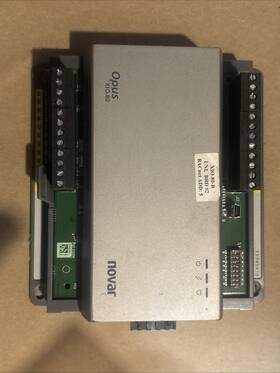
( Brand: Novar ), ( Manufacturer Part Number: XIO-8U-B ), ( Type: Bacnet Remote I/o Module ), ( Voltage: 22 28 Vac, 50/60 Hz, 10 Va )
Review NOVAR Xio 8u Honeywell Opus Bacnet Remote I/o Universal Inputs/output
The **Novar Xio 8U Honeywell Opus Xio.80 BACnet Remote I/O Module** represents a cutting-edge solution for industrial automation and smart building control systems, designed to seamlessly integrate with Honeywell s Opus architecture while delivering high-performance remote input/output (I/O) capabilities. This compact yet robust device is engineered to expand the reach of supervisory control and data acquisition (SCADA) networks, enabling real-time monitoring and control of critical processes across large-scale facilities such as manufacturing plants, data centers, commercial buildings, or energy management systems. With its **8 universal digital inputs and 8 relay outputs**, the Xio.80 provides versatile connectivity options, accommodating a wide range of sensors, switches, and actuators while ensuring precise control over field devices. Each input channel is configurable to support various signal types, including dry contact, 24V DC, or 120V AC, while the relay outputs deliver reliable switching with a robust 10A capacity at 120V AC, making them ideal for driving motors, solenoids, or other high-power loads. The module s **BACnet MS/TP (Master-Slave Token Passing) protocol support** ensures seamless communication with Honeywell s Opus controllers and other BACnet-compatible devices, facilitating efficient data exchange, remote diagnostics, and centralized management through industry-standard protocols. Built with durability in mind, the Xio.80 features a rugged, industrial-grade enclosure that withstands harsh environmental conditions, including temperature fluctuations, humidity, and electrical noise, while its modular design allows for easy installation and scalability within distributed I/O networks. Whether deployed in a mission-critical infrastructure or a high-density automation setup, this module enhances system flexibility, reduces wiring complexity, and minimizes maintenance overhead by consolidating field device control into a single, intelligent interface. Ideal for engineers and facility managers seeking a high-performance, future-proof solution, the Novar Xio 8U Honeywell Opus Xio.80 BACnet Remote I/O Module exemplifies the fusion of advanced communication technology and industrial reliability, ensuring optimal performance in even the most demanding applications.
### **Pros and Cons of buying a Novar Xio-8U Honeywell Opus Xio.80 BACnet Remote I/O (8 Inputs/Outputs)**
#### **Pros:**1. **BACnet Compatibility** The device supports BACnet/IP and BACnet/MS-TP, making it fully compatible with modern building automation systems (BAS). This ensures seamless integration with Honeywell s Opus platform and other BACnet-enabled controllers.
2. **Remote I/O Capability** Allows for distributed I/O, reducing wiring complexity and enabling flexible system expansion. This is particularly useful in large or complex installations where centralized I/O may be impractical.
3. **High Reliability & Durability** Built for industrial and commercial environments, the Xio-8U is designed to withstand harsh conditions, ensuring long-term performance with minimal maintenance.
4. **Scalability** Supports up to 8 discrete inputs/outputs (depending on configuration), allowing for modular growth as system requirements evolve. Additional units can be added without major redesign.
5. **Energy Efficiency Monitoring** Can be used for monitoring binary signals (e.g., occupancy sensors, door contacts, relay control), contributing to better energy management and automation.
6. **Easy Installation & Configuration** Honeywell s Opus platform provides user-friendly tools for setup, wiring, and troubleshooting, reducing installation time and potential errors.
7. **Low Latency Communication** BACnet ensures fast and reliable data exchange, which is critical for real-time control applications like HVAC, lighting, and security systems.
8. **Vendor Support & Warranty** As a Honeywell product, it benefits from strong technical support, documentation, and warranty coverage, reducing downtime risks.
---
#### **Cons:**1. **Cost** Compared to generic or non-BACnet I/O devices, the Xio-8U is more expensive. The premium pricing may not be justified for small or simple installations where basic relays or contactors would suffice.
2. **Complexity for Non-Experts** BACnet configuration and integration require familiarity with building automation protocols. Smaller contractors or DIY enthusiasts may find setup challenging without proper training.
3. **Limited Analog Support** The Xio-8U is primarily designed for discrete (binary) I/O. If analog signals (e.g., temperature, pressure) are required, additional modules or separate devices may be needed, increasing system complexity.
4. **Dependency on Honeywell Ecosystem** While BACnet is an open standard, full functionality may be optimized for Honeywell s Opus platform. Integration with non-Honeywell BAS (e.g., Siemens, Johnson Controls) may require additional configuration or gateways.
5. **Physical Constraints** The unit is a remote I/O device, meaning it must be wired back to the central controller. This may limit flexibility in very large or distributed systems where wireless or other communication methods (e.g., Modbus) might be preferable.
6. **Potential for Overkill** For very small projects (e.g., a single zone HVAC system), the cost and complexity of the Xio-8U may not be justified. A simpler relay-based solution could achieve the same goal at a fraction of the cost.
7. **Firmware/Software Dependencies** Like all networked devices, the Xio-8U relies on firmware updates and software compatibility. Outdated firmware or unsupported Opus versions could lead to compatibility issues.
8. **Limited Local Diagnostics** Unlike some standalone I/O modules, the Xio-8U may require connection to the BAS for full diagnostics. This can complicate troubleshooting in the field.
---
### **Conclusion**
The **Novar Xio-8U Honeywell Opus Xio.80 BACnet Remote I/O** is a robust, high-performance device ideal for **large-scale building automation projects** where BACnet compatibility, scalability, and reliability are critical. Its strengths lie in seamless integration with Honeywell s Opus platform, distributed I/O flexibility, and long-term durability. However, its **higher cost, complexity for non-specialists, and limited analog support** make it less suitable for small or simple applications where basic I/O solutions would suffice.
For **commercial or industrial buildings** with existing Honeywell BAS infrastructure, the Xio-8U is a **strong recommendation** due to its reliability and future-proofing. For **smaller projects, budget-conscious installations, or non-BACnet systems**, alternative I/O solutions (e.g., generic relays, Modbus devices, or wireless sensors) may offer better value.
### **Final Recommendation:** - **Buy the Xio-8U if:**- You are working within a **Honeywell Opus BACnet network**.
- Your project requires **distributed I/O with minimal wiring complexity**.
- You need **long-term reliability and scalability** for large or complex systems.
- Budget constraints allow for a **premium I/O solution**.
- **Avoid the Xio-8U if:**- Your project is **small-scale or low-budget** (e.g., single-zone HVAC, simple lighting control).
- You lack **experience with BACnet or Honeywell systems**.
- You require **analog signals** (consider a separate analog I/O module).
- You are open to **alternative protocols** (e.g., Modbus, LonWorks) for broader compatibility.
For most **mid-to-large commercial or industrial automation projects**, the Xio-8U is a **sound investment** that justifies its cost through efficiency, integration, and long-term performance. For everything else, evaluate alternatives based on specific requirements.
Details:
MPN: XIO 8U B. Type: BACnet Remote I/O Module 8 Universal Inputs/Analog Outputs. Points: 8 configurable universal I/O channels. Model: XIO 8U B / XIO.80.
Condition: Used pulled from service. Brand: Novar Honeywell.
part #: xio8u prices
- $110.00-$125.00
specifications hvaapa:
- brand: Novar
- mpn: Xio-8u-b
- type: Bacnet Remote I/o Module
- voltage: 22 28 Vac, 50/60 Hz, 10 Va
seller hvaapa:
- rating: 100.0%
- # reviews: 1717
- city: Ballwin, Missouri
offer hvaapa:
- started: March 8, 2026
- sold: 0
- quantity: 3
- best offers: True
- availability: In Stock
- options: Ship-to-home
shipping hvaapa:
- transit: 4-8 Days
- service: USPS Ground Advantage
- cost: $0.00
- class: Standard
- type: Calculated
- carrier: USPS
general hvaapa:
- condition: Used
- HVAC Refrigeration > HVAC Refrigeration: Parts Accessories > HVAC Refrigeration: Controls Circuit Boards
payments hvaapa:
- credit card: Visa
- other
- wallet: Paypal
returns hvaapa:
- policy: Returns Accepted
- method: Money back
- time: 30 Days
- paid by: Seller
Novar XIO-8U Is Similar To:
- Novar Controls Corp 739060000 Honeywell Used Tested Cleaned (36% similar) Packaging and handling: items are safely eds packaged in custom shipping cartons for protection. Call to use a shipping service other than the ones listed. Sells new and surplus product develops channels to purchase such. All products are guaranteed to be working but may show signs of use...(August 9th, 2024)
- Novar Controls Corp Xcm.20r Honeywell Xcm20r Used Tested Cleaned (38.7% similar) All products are guaranteed to be working but may show signs of use. Call to use a shipping service other than the ones listed. Sells new and surplus product develops channels to purchase such. Packaging and handling: items are safely eds packaged in custom shipping cartons for protection...(August 16th, 2024)
- Honeywell 32300323-001 Jace-8000 Novar Es1 Niagara 4.10 (25% similar) This unit has less than 50HRS of run time on it. This controller is suitable for hvac refrigeration applications, specifically controlling and monitoring systems in buildings industrial settings. The honeywell JACE-8000 Novar ES1 Niagara 4.10 is a building controller designed for use with systems...(February 1st, 2025)
- Novar Iq220 Honeywell Iq222 24v Ac Dc Controller Module Building Automation (34.1% similar) Honeywell IQ222 IQ220 24V ac dc Novar controller module building automation. Please on the pictures for more details. Cleaned and tested...(May 11th, 2025)
- Novar Opus Xio-8cti-b Electronic Module Xio8ctib 10va 8-universal Inputs Analog Outputs (53.4% similar) Novar electronic module XIO8CTIB 10VA 8-UNIVERSAL inputs analog outputs mpn: XIO-8CTI-B condition: good condition. Orders placed before 4PM CST are commonly shipped same day...(July 11th, 2025)
- Novar Iom 2 Input output Module-relay P n 737006000 0401 (29% similar) Novar IOM/2 input/output module-relay p/n 737006000 0401, s/n 8SOFTWARE V3.06, hardware IOM/2R Afr input 24VAC, 30VA class 2...(January 1st, 2026)
