MITSUBISHI INV16-BOARD Hvac Refrigeration Circuit Board W274735G01
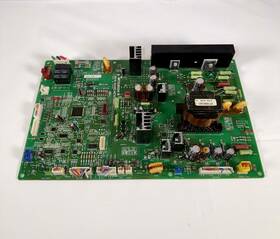
( Brand: Mitsubishi ), ( Manufacturer Part Number: INV16-BOARD ), ( Model: MITSUBISHI INV16-BOARD W274735G01 ), ( Part Type: Hvac Control Circuit Board ), ( Country Of Origin: Japan )
Review MITSUBISHI Board Made In Japan
The **Mitsubishi Electric INV16-Board W274735G01** is a high-performance, compact inverter designed for precision control and energy efficiency in industrial and commercial applications. Part of Mitsubishi s advanced **FR series**, this board serves as the central processing unit for variable frequency drives (VFDs), enabling seamless integration into motor control systems for pumps, fans, conveyors, and other mechanical loads. Engineered with cutting-edge **FPGA (Field-Programmable Gate Array) technology**, the INV16-Board delivers rapid processing speeds, ensuring real-time adjustments to motor speed, torque, and power consumption while minimizing energy waste. Its robust **16-bit architecture** supports complex control algorithms, including vector control, sensorless control, and advanced PID tuning, making it ideal for applications requiring smooth acceleration, deceleration, and precise positioning.
The W274735G01 model is built with **industrial-grade reliability**, featuring a compact yet durable design that accommodates harsh environments, from manufacturing plants to HVAC systems. Its **modular construction** allows for easy installation and maintenance, with a **backplane interface** that facilitates seamless communication with other Mitsubishi components, such as the **FR-F840 or FR-F800 series** inverters. The board incorporates **high-speed communication protocols**, including **Ethernet/IP, Modbus RTU, and Profibus DP**, enabling seamless integration into modern SCADA and PLC systems for centralized monitoring and automation. Additionally, its **wide operating temperature range** (from -10 C to 55 C) ensures consistent performance in fluctuating industrial settings, while **redundant power supply options** enhance system uptime by mitigating potential failures.
One of the standout features of the INV16-Board is its **scalability and flexibility**, allowing users to customize control parameters through intuitive **parameter settings** accessible via Mitsubishi s **GOT (Graphical Operator Terminal)** or third-party HMI systems. The board supports **multiple motor types**, including standard AC induction motors, permanent magnet synchronous motors (PMSM), and brushless DC motors, making it versatile for diverse applications. Its **low harmonic distortion** and **high efficiency** contribute to reduced motor heating and extended equipment lifespan, while **built-in diagnostics** provide real-time feedback on system health, fault codes, and predictive maintenance alerts. Whether deployed in a **high-speed packaging line, water treatment facility, or renewable energy system**, the INV16-Board W274735G01 delivers **superior control accuracy, energy savings, and operational resilience**, making it a cornerstone for modern motor automation solutions.
### **Mitsubishi INV16-Board (W274735G01) Pros and Cons**
#### **Overview**
The Mitsubishi INV16-Board (W274735G01) is a variable frequency drive (VFD) designed for controlling three-phase AC motors. It is part of the **FR series**, known for industrial applications such as pumps, fans, conveyors, and HVAC systems. Below is a detailed analysis of its advantages and disadvantages.
---
### **Pros**
1. **High Reliability and Durability**
- Mitsubishi is a well-established brand with decades of experience in industrial automation, ensuring robust build quality and long-term performance.
- The unit is designed for harsh industrial environments, with features like overvoltage/undervoltage protection, short-circuit protection, and thermal overload protection.
2. **Wide Voltage and Current Range**
- Supports a broad input voltage range (380 480V AC, 50/60Hz), making it suitable for various global power systems.
- Handles motor currents up to **16A**, which is adequate for small to medium-sized motors (typically up to 7.5 kW at 400V).
3. **Advanced Control Features**
- Includes **scalar (V/f) and vector control** modes, allowing precise speed and torque control for applications requiring smooth acceleration/deceleration.
- **PID control** for process automation, enabling stable speed regulation in systems like pumps and compressors.
- **Regenerative braking** capability to recover energy during deceleration, improving efficiency in certain applications.
4. **User-Friendly Interface**
- Features a **color LCD display** with intuitive menus, making setup and monitoring straightforward.
- Supports **remote control via RS-485 (Modbus RTU)** and **analog inputs/outputs**, allowing integration with PLCs or SCADA systems.
5. **Energy Efficiency**
- Reduces energy consumption by adjusting motor speed to demand, leading to cost savings in applications like variable flow systems.
- Low harmonic distortion due to advanced PWM (Pulse Width Modulation) technology, minimizing strain on the electrical system.
6. **Compact and Modular Design**
- The **16A rating** makes it space-efficient for installations where floor space is limited.
- Compatible with Mitsubishi s **GOT (Graphical Operator Terminal)** and other automation products for seamless system integration.
7. **Good Warranty and Support**
- Mitsubishi offers **standard warranties (typically 2 5 years)** and extensive after-sales support, including spare parts and technical assistance.
- Widely available in the market, with service centers and distributors globally.
8. **Cost-Effective for Small to Medium Applications**
- Priced competitively compared to higher-end VFDs, making it a practical choice for budget-conscious projects without sacrificing performance.
---
### **Cons**
1. **Limited Current Rating (16A)**
- The **16A maximum current** restricts its use to smaller motors (usually up to 7.5 kW at 400V). Larger applications (e.g., 15 kW ) will require a higher-rated model (e.g., INV20 or INV30 series).
- May struggle with motors requiring high starting torque or frequent heavy loads.
2. **Basic Communication Protocols**
- While it supports **Modbus RTU**, it lacks more advanced protocols like **Ethernet/IP, Profibus, or Modbus TCP**, which may limit integration in modern industrial networks.
- No built-in **wireless connectivity** (Wi-Fi/Bluetooth), requiring wired communication setups.
3. **No Built-In Energy Saving Modes (Advanced)**
- While it reduces energy consumption through speed control, it lacks **AI-driven energy optimization** or **predictive maintenance features** found in higher-end VFDs.
4. **Physical Size and Installation Constraints**
- The unit is **not DIN-rail mountable** (unlike some competitors), requiring panel or wall mounting, which may complicate installation in tight spaces.
- Cooling relies on **natural convection** (no fan), which may limit performance in high-ambient-temperature environments unless additional cooling is provided.
5. **Software Limitations**
- The **configuration software (FR Configurator)** is functional but not as feature-rich as some competitors (e.g., Siemens, ABB).
- No **cloud connectivity or remote monitoring** out of the box, requiring additional hardware for advanced diagnostics.
6. **Potential for Higher Maintenance Costs Over Time**
- While reliable, like all electronic devices, it may require **periodic firmware updates** or part replacements (e.g., capacitors, contactors) as it ages.
- Some users report **sensitivity to power quality issues** (e.g., spikes, harmonics), which may shorten lifespan if not properly filtered.
7. **Learning Curve for Advanced Features**
- While the interface is user-friendly, **vector control and PID tuning** require some expertise, which may be a barrier for non-technical operators.
---
### **Conclusion**
The **Mitsubishi INV16-Board (W274735G01)** is a **solid, mid-range VFD** ideal for small to medium industrial applications where **reliability, simplicity, and cost-effectiveness** are priorities. It excels in **pump control, HVAC systems, and conveyor applications** where precise speed regulation is needed but high power demands are not.
However, it is **not suitable for high-power applications** (above 7.5 kW) or systems requiring **advanced networking, wireless control, or AI-driven efficiency features**. For such needs, a higher-rated model (e.g., INV20, INV30) or a competitor with more modern features (e.g., ABB ACS880, Siemens SINAMICS G120) may be preferable.
---
### **Recommendation**
**Buy the Mitsubishi INV16-Board if:**- You need a **reliable, cost-effective VFD** for **small motors (up to 7.5 kW)** in applications like **pumps, fans, or conveyors**.
- Your system requires **scalar or basic vector control** with **Modbus RTU communication**.
- You prioritize **Mitsubishi s brand reputation** and **easy availability of spare parts**.
- The environment is **not extremely harsh** (e.g., high dust, humidity, or temperature fluctuations).
**Avoid or Consider Alternatives if:**- You require **higher power ratings** (above 16A/7.5 kW).
- Your application demands **advanced networking (Ethernet/IP, Profibus)** or **wireless control**.
- You need **AI-driven energy optimization** or **predictive maintenance features**.
- You are working in a **highly corrosive or extreme-temperature environment** (consider an **IP65-rated or explosion-proof model**).
- You prefer **more intuitive or feature-rich configuration software**.
**Alternatives to Consider:**- **Mitsubishi INV20/INV30 Series** For higher current ratings (up to 32A/50A).
- **ABB ACS880** Better networking and advanced features for larger systems.
- **Siemens SINAMICS G120** Strong in industrial automation with better diagnostics.
- **Delta VFD (e.g., DVA Series)** Competitive pricing with good reliability.
**Final Verdict:**The **INV16-Board is a practical choice for its intended use case**, but buyers should carefully assess their specific requirements before purchasing. For most **small-scale industrial applications**, it offers a **good balance of performance, cost, and support**.
Details:
Mitsubishi Board INV16-BOARD W274735G01. Made in Japan.
part #: inv16 price
- $1250.00
specifications hvaapa:
- brand: Mitsubishi
- mpn: Inv16-board
- model: Mitsubishi Inv16-board W274735g01
- part type: Hvac Control Circuit Board
- country of origin: Japan
general hvaapa:
- condition: Used
- HVAC Refrigeration > HVAC Refrigeration: Parts Accessories > HVAC Refrigeration: Controls Circuit Boards
returns hvaapa:
- paid by: Buyer
- policy: Returns Accepted
- time: 30 Days
- method: Money back
offer hvaapa:
- quantity: 1
- sold: 0
- availability: In Stock
- started: May 1, 2026
- options: Ship-to-home
seller hvaapa:
- rating: 100.0%
- # reviews: 10
- city: US
payments hvaapa:
- credit card: Diners-club
- other
- wallet: Google-pay
shipping hvaapa:
- carrier: USPS
- cost: $0.00
- transit: 4-10 Days
- class: Expedited
- type: Fixed
- service: USPS Priority Mail, USPS Priority Mail Express
Mitsubishi INV16 Is Similar To:
- Ke76b218g04 Mitsubishi Air Conditioning Indoor Pc Power Board (35.1% similar) This is a Mitsubishi air conditioning PC power control board model KE76B218G04. This board was removed from a system that replaced but is in good working condition...(November 7th, 2018)
- Mxz-5a100va-e1 Mitsubishi Mini Split Pcb Noise Filter Board For Units (39.3% similar) Mitsubishi noise filter board for MXZ-3 MXZ-4 units for the following UNITS:MXZ-3A30NA-1MXZ-4A36NAMXZ-3B24NAMXZ-3B24NA-1MXZ-3B30NAMXZ-3B30NA-1MXZ-4B36NAMXZ-4B36NA-1OTHER numbers on and package include 12V40422 YDM76N10502DM00N106MXZ-5A100VA-E1...(July 2nd, 2018)
- Mitsubishi Electric Dm00n776 Msy-ge12na-9 Electronic Control Board Sm76a270 (34.4% similar) MSY-GE12NA-9 electronic control board DM00N776 SM76A270. Shipped with USPS ground advantage. Condition is used...(August 5th, 2024)
- Mitsubishi Dm00y587 Ductless Unit Control Board Dm76y597g01 (46.4% similar) Mitsubishi ductless unit control board DM00Y587 DM76Y597G01. Shipped with USPS ground advantage. Condition is used...(August 13th, 2024)
- Mitsubishi Dm00j797 Oem Ductless Control Board Hvac Dm76j796g04 (41.4% similar) Oem Mitsubishi DM00J797 ductless control board hvac DM76J796G04. Condition is used. Shipped with USPS priority mail...(August 13th, 2024)
- Mitsubishi Rg00v525 Control Board Module Hvac Rg76v526g01 (47.3% similar) Mitsubishi control board module RG00V525 hvac RG76V526G01, good used condition - removed from a working application...(August 17th, 2024)
- Mitsubishi Ke76b541g02 Conect01 Pcb Circuit Board (41.2% similar) Mitsubishi CONECT01 KE76B541G02, used working KE76B541G02...(August 17th, 2024)
- Mitsubishi Dm00n329 Air Conditioning Control Board Dm00n329b Dm76y837g02 (38.4% similar) Shipped with USPS priority mail. Mitsubishi air conditioning control board DM00N329B DM76Y837G02 DM00N329. Condition is used...(August 22nd, 2024)
- Mitsubishi Electric Dm00j840 Dm00n642 Dm00j8400 Main Control Printed Circuit Board Module (32.4% similar) Mitsubishi electric DM00N642 DM00J8400 main control printed circuit board module. Used working condition. Condition notes: good...(August 23rd, 2024)
- Mitsubishi 06s60701 Smart Inverter Conditioner Control Board Rg00n937b Rg76y099g04 (40% similar) Condition is used. Shipped with USPS ground advantage. Mitsubishi smart inverter conditioner control board RG00N937B RG76Y099G04...(August 24th, 2024)
