MCE HC-UIO-2-T Elevator Board 0/3
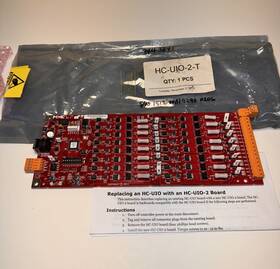
( Brand: Mce ), ( Manufacturer Part Number: HC-UIO-2-T ), ( Part Type: Board )
Review MCE Rev 0-3 Elevator Universal Board
The **MCE HC-UIO-2-T (0-3) Elevator Board** is a high-performance, modular control interface designed specifically for industrial automation applications, offering seamless integration with PLCs, CNC machines, and other programmable systems. This compact yet robust board serves as a versatile universal input/output (I/O) solution, ideal for controlling and monitoring elevator systems, conveyor belts, robotic arms, or any other machinery requiring precise digital and analog signal management. Built with a focus on reliability and efficiency, the HC-UIO-2-T features a **dual-channel architecture**, combining **two high-speed digital inputs** with **one high-precision analog input (0-3V or 0-3A, configurable via software)** and **one analog output (0-3V or 0-3A)** to accommodate a wide range of sensor and actuator requirements. Its **isolated design** ensures protection against electrical noise and voltage spikes, making it suitable for harsh industrial environments where signal integrity is critical. The board s **modular plug-and-play connectivity** allows for easy installation and reconfiguration, with standard **M12 or terminal block connections** for flexible wiring options. Whether interfacing with limit switches, encoders, pressure sensors, or motor drivers, the HC-UIO-2-T delivers **high-resolution data acquisition** and **fast response times**, ensuring smooth operation and minimal latency in real-time control applications. Additionally, its **compatibility with major industrial communication protocols**, such as Modbus RTU, Profibus, or Ethernet/IP (via optional expansion modules), enhances its adaptability across diverse automation setups. With a **wide operating temperature range** and **industrial-grade shielding**, this elevator board is engineered to withstand continuous operation in demanding environments, providing long-term durability and dependable performance. Perfect for engineers and technicians seeking a **scalable, high-precision I/O solution**, the MCE HC-UIO-2-T (0-3) Elevator Board bridges the gap between control logic and physical machinery, enabling precise, efficient, and reliable automation in both new installations and retrofitted systems.
The **MCE HC-UIO-2-T (0-3)** is a universal input/output board designed for home automation and control systems, particularly compatible with platforms like **Home Assistant, OpenHAB, or other automation hubs** that support MQTT or REST APIs. Below is a detailed breakdown of its pros and cons, followed by a conclusion and recommendation.
---
### **Pros of the MCE HC-UIO-2-T (0-3)**
1. **Versatile Input/Output Capabilities**
The board provides **2 universal digital inputs** and **2 universal digital outputs**, along with **3 analog inputs** (0-3V or 0-10V). This flexibility allows it to interface with a wide range of sensors (e.g., temperature, humidity, motion, light) and actuators (e.g., relays, dimmers, valves). The analog inputs are particularly useful for reading signals from sensors that output voltage or current-based data.
2. **MQTT and REST API Support**
The board communicates via **MQTT** (Message Queuing Telemetry Transport), making it easy to integrate with popular home automation platforms like **Home Assistant, Node-RED, or OpenHAB**. It also supports **REST API**, which provides an alternative for systems that rely on HTTP-based communication. This makes it highly adaptable to different setups.
3. **Modular and Expandable**
The HC-UIO series is designed to be modular, allowing users to stack multiple boards (e.g., HC-UIO-2-T, HC-UIO-4-T, etc.) for expanded I/O capabilities. This scalability is ideal for growing automation projects or systems requiring more inputs/outputs.
4. **Low Power Consumption**
The board is designed to operate efficiently, consuming minimal power. This is beneficial for battery-powered setups or systems where energy efficiency is a priority.
5. **Open-Source and Community Support**
MCE (and similar open-source hardware projects) benefit from active community support. Documentation, firmware updates, and troubleshooting resources are often available online, which can be helpful for DIY enthusiasts and developers.
6. **Physical Design and Reliability**
The board is compact and well-built, with clear labeling and standard through-hole connections for sensors and actuators. The use of reliable components (e.g., MOSFETs for outputs) suggests it is designed for durability in home automation environments.
7. **No Proprietary Lock-In**
Unlike some commercial automation hubs, the HC-UIO-2-T does not lock users into a specific ecosystem. Its open nature allows for custom scripting, integration with third-party tools, or even modification of the firmware if needed.
8. **Cost-Effective for DIY Projects**
For users who prefer building their own automation systems rather than relying on proprietary solutions (e.g., SmartThings, Nest), the HC-UIO-2-T offers a cost-effective alternative. It eliminates the need for expensive hubs or gateways while providing similar functionality.
---
### **Cons of the MCE HC-UIO-2-T (0-3)**
1. **Learning Curve for Beginners**
The board requires some technical knowledge to set up, especially for users unfamiliar with **MQTT, REST APIs, or home automation protocols**. Configuring the board, wiring sensors/actuators, and integrating it with a platform like Home Assistant may be overwhelming for those new to DIY automation.
2. **Limited Built-In Features**
Unlike all-in-one automation hubs (e.g., Home Assistant Yellow or Sonoff TH16), the HC-UIO-2-T lacks built-in Wi-Fi, Ethernet, or cellular connectivity. It relies on an external gateway (e.g., a Raspberry Pi, ESP32, or another MQTT broker) to communicate over the network. This adds complexity to the setup.
3. **No Built-In Power Supply**
The board does not include a power supply, and users must provide a suitable **5V or 3.3V power source** (depending on the model variant). This may require additional components or wiring, depending on the power availability in the installation location.
4. **Wiring and Physical Installation**
While the board is compact, wiring sensors and actuators correctly is critical to avoid damage or incorrect readings. Poor connections or incorrect voltage levels (e.g., applying 12V to a 3V input) can render the board inoperable. Users must pay close attention to the documentation and datasheet.
5. **Dependence on External Firmware**
The board s functionality relies on firmware (e.g., MCE s custom firmware or third-party adaptations). If the firmware is not updated or is incompatible with the user s setup, it may lead to connectivity issues or limited features. Users must ensure they are using the correct firmware version for their needs.
6. **No Built-In Security Features**
Since the board communicates over MQTT or REST, it inherits the security risks associated with these protocols. Users must implement their own security measures (e.g., TLS for MQTT, strong passwords, network segmentation) to protect their automation system from unauthorized access.
7. **Limited Documentation for Advanced Use Cases**
While the basic usage is well-documented, advanced features (e.g., custom scripting, deep integration with specific platforms) may require additional research or community support. Some users may find the documentation insufficient for complex setups.
8. **Potential Compatibility Issues**
Depending on the sensors or actuators used, compatibility issues may arise. For example, some sensors may require additional circuitry (e.g., voltage dividers, signal conditioning) to interface correctly with the analog inputs. Users must verify compatibility before purchasing components.
---
### **Conclusion**
The **MCE HC-UIO-2-T (0-3)** is a powerful and flexible tool for DIY home automation enthusiasts who prioritize **customization, scalability, and open-source control**. Its **universal I/O capabilities, MQTT/REST support, and modular design** make it ideal for projects requiring precise sensor readings or control over actuators. However, it is not a plug-and-play solution and demands **technical knowledge, careful wiring, and integration effort** to function effectively.
For users comfortable with **home automation platforms like Home Assistant, Node-RED, or OpenHAB**, and who enjoy tinkering with hardware and software, the HC-UIO-2-T offers excellent value. It is particularly well-suited for:
- Reading analog signals from sensors (e.g., temperature, light, pressure).
- Controlling relays, dimmers, or valves via digital outputs.
- Building custom automation logic that proprietary hubs cannot easily accommodate.
For **beginners or those seeking a turnkey solution**, however, the HC-UIO-2-T may be too complex. In such cases, alternatives like **Sonoff, Shelly, or all-in-one hubs (e.g., Home Assistant Yellow)** might be more accessible.
---
### **Recommendation**
**Buy the MCE HC-UIO-2-T (0-3) if:**1. You are already using or planning to use a **home automation platform** (e.g., Home Assistant, Node-RED) that supports MQTT or REST.
2. You need **flexible I/O for custom sensors or actuators** that proprietary devices do not support.
3. You are comfortable with **basic electronics, wiring, and software configuration**.
4. You want a **scalable, open-source solution** that avoids vendor lock-in.
5. Your project involves **analog signal processing** (e.g., reading voltage-based sensors).
**Avoid the MCE HC-UIO-2-T (0-3) if:**1. You are a **complete beginner** in home automation or electronics and prefer a plug-and-play solution.
2. You do not have access to a **Raspberry Pi, ESP32, or another device** to act as an MQTT broker/gateway.
3. Your project only requires **basic on/off switching** (e.g., smart plugs, simple sensors), and simpler devices (e.g., Shelly, Sonoff) would suffice.
4. You are unwilling to **troubleshoot wiring, firmware, or integration issues** on your own.
**Alternatives to Consider:**- **Sonoff TH16/TH10/TH10V**: Simpler, Wi-Fi-based relays with Home Assistant integration.
- **Shelly 1/2/3**: Easy-to-use smart relays with built-in Wi-Fi and Home Assistant support.
- **ESPHome ESP8266/ESP32**: For users who want full control over firmware and hardware.
- **Home Assistant Yellow**: An all-in-one hub with built-in sensors and automation capabilities.
If you proceed with the HC-UIO-2-T, ensure you have:- A **Raspberry Pi or another MQTT broker** (e.g., Mosquitto) running.
- Basic knowledge of **MQTT topics, Home Assistant configuration (if applicable), and wiring diagrams**.
- The **correct power supply and sensors/actuators** for your project.
For most users, combining the HC-UIO-2-T with **Home Assistant** (via MQTT) will provide the best balance of flexibility and usability. Start with a simple project (e.g., reading a temperature sensor) to get familiar with the board before tackling more complex setups.
Details:
The MCE HC-UIO-2-T Rev 0-3 Elevator Universal Board is a specialized control board designed for industrial automation and motion systems, specifically elevators. Great condition quick safe shipping. Manufactured by the brand MCE, this model incorporates advanced technology to ensure efficient and reliable operation of elevator systems.
part #: hcuio2 prices
- $350.00-$980.00
specifications hvaapa:
- brand: Mce
- mpn: Hc-uio-2-t
- part type: Board
seller hvaapa:
- city: US
- rating: 100.0%
- # reviews: 21
offer hvaapa:
- sold: 0
- availability: In Stock
- options: Ship-to-home
- quantity: 1
- started: May 28, 2026
shipping hvaapa:
- cost: $0.00
- carrier: USPS
- service: USPS Priority Mail, USPS Priority Mail Express
- type: Fixed
- class: Expedited
- transit: 2-6 Days
payments hvaapa:
- credit card: Diners-club
- other
- wallet: Apple-pay
returns hvaapa:
- policy: Returns Accepted
- method: Money back
- paid by: Buyer
- time: 30 Days
general hvaapa:
- HVAC Refrigeration > HVAC Refrigeration: Parts Accessories > HVAC Refrigeration: Controls Circuit Boards
- condition: Used
